P.E.T. VR Program – Help Fund the First Empathy-Based VR Rehab for Animal and Domestic Abuse

Organized by P.E.T. – Psychosensory Empathy Training






About This Fundraiser
What if abusers could feel what they’ve done—without shame, without cruelty—just truth?
For almost 40 years in forensic and clinical work, I have watched the same pattern repeat.
* An animal is hurt.
* A partner or child is terrorized.
The offender learns the right words to say, completes a class, and is marked “compliant.” On paper, case closed. Inside their nervous system, very little has changed.
==========================
Case: Eric, 14.
Eric started with insects, then stray cats behind the building. At 14 he was on probation for beating a neighbor’s dog with a metal pipe. In counseling he drew violent scenes, laughed at the dog’s injuries, and said, “It’s just a dog.” When his supervision ended, his file closed. No one knows which victim came next.
Case: Daniel, 31.
Daniel had no prior record when he was charged with domestic assault. At home the pattern had been there for years. Raised voices. Doors slammed near his wife’s head. Long, punishing silence. Then the first shove. By the time police were called, his 6-year-old daughter had watched him grab her mother by the throat on more than one occasion. The court ordered a batterer intervention group. Daniel sat in the back, repeated the language he knew would satisfy the program, and told his probation officer, “We were both out of line.” He was discharged as “completed.” His body’s reaction to his own family had never been tested.
==========================
P.E.T. (Psychosensory Empathy Training) is the intervention that did not exist for Eric or Daniel.
PET VR is a trauma-informed program designed to build empathy in offenders without lectures, loopholes, or shame. After 7 years of clinical development and behavioral mapping on paper, and 2 years of VR and haptic planning, we are ready to build the prototype.
==========================
The first pilot will look something like this.
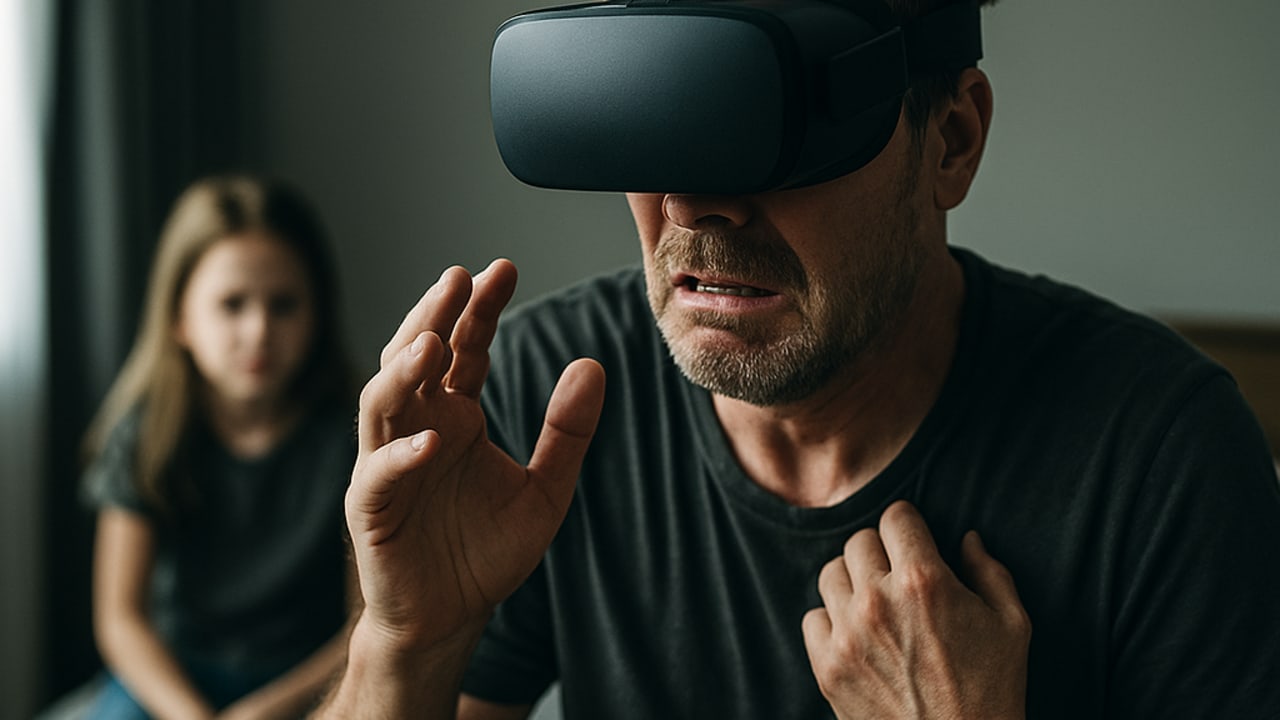
A probation officer escorts a 24-year-old offender into a small room in a county building. He is on supervision for cruelty and still believes “it was not that bad.” A P.E.T. headset and sensors are fitted. In the first module he enters the scene from the victim’s sensory point of view.
* He hears his own recorded words from the night of the offense.
* He feels the approach of the blow in slow motion, then at full speed.
His heart rate climbs. His palms sweat. For the first time, his body reacts as if he is the one at risk.
P.E.T. uses that physiological crack in the wall as the doorway to change.
Over 90 days, the protocol keeps that door open long enough for new associations to form and hold.
This is not a PSA.
This is not a workshop.
This is direct behavioral intervention.
Using a combination of neuroscience, immersive VR, and sensor-based feedback, P.E.T. places offenders into realistic, non-traumatizing simulations that interrupt cycles of violence by activating empathy.
The program was developed solely by me, Dr. Mozelle Martin, a forensic professional with nearly 40 years in psychology, criminology, and victimology. As a former Clinical Director of a trauma treatment center, I built P.E.T. on forensic science, behavioral intervention, and restorative ethics.
It is:
- Court-adaptable
- Ethically engineered
- Designed for both juvenile and adult systems
Ideal for use with:
• Animal cruelty offenders
• Domestic violence perpetrators
• Juvenile and adult justice programs
• Aggression rehabilitation settings
It’s immersive, not triggering.
It’s ethical, not preachy.
And it targets the gap where standard classes and punishment fail.
We are fiscally sponsored by Chappy & Friends, a 501(c)(3) nonprofit, and are raising funds to build the first full-scale P.E.T. prototype.
Your tax-deductible donation will fund:
• VR scene development for real-world offense patterns
• Sensor-integrated biometric feedback loops for measurable outcomes
• Clinical testing and program validation with justice-involved populations
• Deployment for courts, community corrections, and mental health centers, starting in the USA
Right now there are offenders already on probation for animal cruelty and domestic violence who will hurt again because nothing in the system has changed how their brain perceives their victims. P.E.T. exists so the next animal, partner, or child is not used as a practice target.
That's why we need your help.
Updates

11 months ago
As we head into the final weeks of 2025, a lot of people are asking the same question: “Where can I put my year-end, tax-deductible donation so it actually prevents harm instead of just reacting to it?”
P.E.T. – Psychosensory Empathy Training – was built for the cases that keep showing up in the news:
• the man caught on camera strangling a kitten in a San Antonio stairwell,
• the repeat offender with a record of harming both animals and people,
• the chronic abuser who walks out of court, unchanged, and goes looking for a new target.
These are not “one-off” monsters. They are predictable outcomes of systems that punish on paper but never touch the part that is broken: empathy.
P.E.T. uses immersive VR, haptics, and trauma-informed design to do what lectures, fines, and short jail terms have failed to do for decades:
make offenders feel the impact of their actions in a controlled, measurable way, without using real victims and without crossing ethical lines.
Your tax-deductible donation through our 501(c)(3) fiscal sponsor, Chappy & Friends, goes directly toward building the first full P.E.T. prototype:
• engineering the VR and sensor system,
• building court-adaptable modules for animal cruelty, domestic violence, and related offenses,
• and validating the program so judges, probation officers, and advocates have a real alternative to “slap on the wrist and hope.”
If you’ve ever watched a story like the San Antonio kitten case and thought, “He is going to hurt someone else if he's not helped or in prison,” this is one concrete way to interrupt that trajectory before the next victim appears.
Thank you for helping us turn outrage into infrastructure.
— Dr. Mozelle Martin
Creator, P.E.T. – Psychosensory Empathy Training

about 1 year ago
Big News: PET VR is now on TerraCycle!
We’re excited to share that the P.E.T. VR Program has officially been added as a recognized charity through TerraCycle Recycling Rewards.
That means anyone who recycles through TerraCycle can now donate their earned points directly to support PET VR. Every 2,500 points equals a $25 donation, and TerraCycle pays out to us twice a year.
✅ How you can help:
-
Keep recycling through TerraCycle.
-
When you redeem your points, simply choose PET VR from the list of charities.
-
Your everyday recycling will directly fund our work to rewire empathy through immersive VR.
Thank you for continuing to support PET VR in creative, sustainable ways. Together, we’re proving that waste can fuel empathy and change lives.

about 1 year ago
USA News just published a feature on the Psychosensory Empathy Training (P.E.T.) program.
The piece covers why punishment alone doesn’t stop violence, how empathy can be rewired through immersive VR and sensory technology, and why prevention is cheaper than paying the costs of cruelty after the fact.
