Our Mission
Orangutan Outreach's mission is to protect orangutans in their native forests of Borneo and Sumatra while providing care for orphaned and displaced orangutans until they can be returned to their natural environment. If they cannot be released, we will do everything in our power to ensure they have a life of dignity and the best possible long-term care. We seek to raise funds and promote public awareness of orangutan conservation issues by collaborating with partner organizations around the world.
How Your Donations Help
- $12,000 releases 1 orangutan by helicopter in Indonesia
- $5,500 helps release 1 orangutan by land in Indonesia
- $4,000 helps care for and rehabilitate 1 orangutan for 1 year in Indonesia
- $300 helps rescue 1 orangutan from illegal captivity in Indonesia
- $7 plants, monitors, and protects 1 tree in Indonesia
Donate via Pledge
This database listing is not affiliated with or endorsed by Orangutan Outreach. Donations to Pledgeling Foundation, a 501(c)(3) donor-advised fund, will be regranted to Orangutan Outreach under the Terms of Service.
Our Impact
about 2 years ago — North Sumatra, Indonesia

Sumatra: The Orangutan Haven is a Reality! We have some incredible news to share and celebrate! The Swiss NGO PanEco Foundation and its Indonesian partner Yayasan Ekosistem Lestari YEL (Sustainable Ecosystem Foundation) recently announced that the first orangutans have moved into their amazing new facility in Sumatra, Indonesia: The Orangutan Haven. Four of eight “unreleasable” orangutans have moved from the Sumatran Orangutan Conservation Programme (SOCP) Quarantine Center to their NEW HOME at the gorgeous Orangutan Haven. Each of these precious unreleasable orangutans is now out of their cage and has been given a forested island on which to live! Orangutan Outreach has been supporting SOCP for many years and has been there every step of the way in the 10-year journey to create the Orangutan Haven. It is a beautiful sanctuary that will be the forever home to eight special orangutans, all of whom have physical or psychological challenges that keep them from returning to life in the forest. Since orangutans can live 50 years or more, the Orangutan Haven was created to provide these eight individuals the best possible care and welfare for the rest of their lives. They will live on large naturally vegetated islands, rather than living out their days in the metal cages they previously occupied at the SOCP Quarantine Center. The islands are equipped with climbing structures, ropes, plants, nesting baskets and freshwater drinking pools, and are separated from each other by wide water moats. The islands will allow the orangutans to live a much more natural and enriched life, while still receiving all the care they need. Krismon (from the Orangutan Outreach adoption program) was the first cheekpadder to move on September 12, 2023. Next to move was Leuser on October 5. They were followed by Paguh on October 17 and Dina on November 7. All four orangutans are doing well, and are adjusting to their new home. On October 19, Leuser became the first orangutan out onto his island and by the end of November; the other three precious orangutans had come out to explore their lush surroundings. On the day adult male orangutan Leuser emerged from his night house onto his island, Dr. Ian Singleton, Conservation Manager of the Orangutan Haven, remarked: “This was a huge day for all of us, but especially for Leuser himself. We had no idea how he was going to find his way around and map out his new environment but he went straight up a rope from his indoor quarters to one of the nest baskets provided on the island, 6m off the ground. Since then he’s been exploring the ropes and timbers around his nest baskets, gradually visiting new features and new areas every day. It’s just fascinating to watch this process and imagine what is going through his head as he develops a mental map of his new world”. What makes this even more amazing is that Leuser is blind in both eyes! He was shot 62 times with an air rifle, including twice in one eye and once in the other, during a conflict with local farmers. It is absolutely remarkable that he has the confidence to explore his island and climb as high as he can go! Paguh is also blind due to being shot with an air rifle, and young Dina (at left) is blind due to contracting encephalitis, an infection of the brain. These two are also showing much courage as they learn to navigate around their islands. Sweet, gentle Krismon is not blind but has many chronic health conditions and weakness in his legs due to having been in a very cramped cage for so many years while he was an illegal pet. He is becoming bolder every day as he ventures further out onto his island. It is heartwarming to see each of the orangutans beginning their new life at the Haven. We hope you are as thrilled as we are with this Orangutan Haven news! After 10 years of planning, the remarkable Orangutan Haven is a reality! We also hope this makes you smile and helps you realize what your support has done. Remember – not all of the orangutans are "home" yet! SOCP still needs to transfer four more orangutans in the next few months. Funding is still very much needed to secure the transfers, complete the Haven infrastructure, and to care for each of the orangutans for the remainder of their long lives.
almost 5 years ago — Central Kalimantan, Indonesia

Borneo Nature Foundation Launches ‘One Million Trees’ Project Borneo Nature Foundation (BNF) has launched an exciting new project to plant one million trees over the next five years in the Sebangau Forest, Central Kalimantan. This project is an effort to restore the ecological function of the burned areas of the forest. BNF International Executive Director Simon J Husson said that the one million tree project will be implemented in stages, starting in the area of the Natural Peat Forest Laboratory (LAHG) Sebangau. In its implementation, BNF collaborates with the Center for International Cooperation in Sustainable Management of Tropical Peatland (CIMTROP) UPR and Sebangau Forest National Park. “The planting of one million trees is aimed at restoring the ecological function of the Sebangau forest, especially in terms of carbon sequestration and habitat restoration for endangered species, such as orangutans, for various reasons, mainly due to forest fires and illegal logging in the past,” said Simon. Based on the results of BNF’s scientific research over the last few years, it is estimated that there are 65 species of mammals, 172 birds, 11 amphibians, 46 reptiles, and 55 fish. 22 of the vertebrate species are endemic, and 6 mammal species are endangered. There is also a population of 6000 critically endangered orangutans, living in the Sebangau area. In order to support and succeed in achieving the goal of planting one million trees, BNF also carries out various community empowerment activities for habitat protection and sustainable development. These outreach activities help build multi-stakeholder networks to increase community involvement in reforestation activities, and encourage the participation of women, promoting a green economy for local communities, and helping to alleviate poverty. 40,000 Seedlings As part of the implementation phase of the one million trees project, in March and April 2021, 40,000 tree seedlings will be planted in a 100 hectare burnt area of the Ruslan LAHG Sebangau forest. This is a continuation of the habitat restoration efforts made by BNF in 2020, whereby 50,600 seedlings were planted across 50 hectares. Meanwhile, Deputy Director of BNF Indonesia, Yunsiska Ermiasi said that planting 40,000 tree seedlings in a 100 hectare area was also part of BNF’s efforts to expand the planting area, increase the number of existing seedlingss, and increase the capacity of the Kereng Bangkirai and Sabaru community nurseries to support reforestation and activities. “This planting event is supported by donors from various countries who have the same hope, namely in the form of ongoing reforestation efforts in the peat area in Sebangau,” she said. BNF Nursery Officer, Koesmyadi added, of the 40,000 tree seedlings that will be planted in March, as many as 20,000 tree seedlings have already been mobilized to the nursery area. Meanwhile, the rest is still in process. The seedlings are taken directly from the forest before being raised in the nursery until they are ready for planting. Locally grown tree species to be planted include; belangeran (Sorea belangeran), prupuk (Lophopetalum sp.), tempohot (Syzigium sp.), jambu-jambu (Eugenia sp.), gerunggang (Cratoxylon arborescens), papung (Sandoricum beccanarium), tabaras (Stemonorus scorpioides), and patanak galeget (Eleocarpus sp.). All reforestation activities carried out in Sebangau forest are thanks to the support of Orangutan Outreach and numerous other charity partners from across the globe.
9 months ago — Central Kalimantan, Indonesia

Big News from the BOS Foundation! Moving an orangutan rehabilitation center to a new location is no easy task! Yet that is exactly what Borneo Orangutan Survival (BOS) Foundation has done - because it is what is best for the orangutans! In the new location, the orangutans from the BOS Foundation Nyaru Menteng rehabilitation center have an expanded Forest School area, a new playground, and large night houses full of enrichment items. The Nyaru Menteng Orangutan Rehabilitation and Conservation Area in Central Kalimantan (Borneo) is operational yet requires further development. Still to be completed are supporting facilities such as a clinic, fruit storage, offices, and socialization enclosures. Happily, the new Forest School, which was a priority, stands ready for the students! Reason for the Relocation Relocating the Nyaru Menteng center marks an important step in ensuring that orangutans undergoing rehabilitation can learn and develop more effectively in one integrated area. Previously, the Nyaru Menteng rehabilitation facility was situated in an area that has now been designated as a communal urban forest. While the urban forest brings benefits to the surrounding community, this location was less than ideal for an orangutan rehabilitation center. The frequent human presence around the facility could disrupt the learning process of orangutans, who should have minimal human interaction. Therefore, a new location that is quieter and free from human disturbances was chosen to ensure the rehabilitation process adheres to the highest animal welfare standards. Inauguration Day The official inauguration of the Nyaru Menteng Orangutan Rehabilitation and Conservation Area was a wonderful day. Raja Juli Antoni, the Indonesian Minister of Forestry proclaimed, "Absolutely inspiring! I am deeply moved by the dedication of individuals who tirelessly work to protect our forests and biodiversity, especially orangutans." The Head of the Natural Resources Conservation Agency (BKSDA) of Central Kalimantan, Persada Agussetia Sitepu, had this to add, "Orangutans are a crucial species in the Borneo forest ecosystem. Therefore, it is important for all of us—government, the public, and NGOs like BOS Foundation—to work together in the conservation of orangutans and their habitat." With the move to the new site, the Nyaru Menteng Center now has a more conducive environment to support the development of young orangutans. A more natural setting with minimal human distractions is expected to enhance the effectiveness of rehabilitation, allowing orangutans to focus on learning survival skills such as foraging, nest-building, and recognizing potential dangers in the wild. Additionally, this relocation supports long-term conservation efforts. With a more optimal rehabilitation process, orangutans that are ready for release have a greater chance of successfully surviving when they are eventually released to freedom in the forest. Orangutans on the Move! The first phase of the relocation was the transfer of the Forest School (which will continue to be developed to provide optimal education and skills training for the orangutans). Soon it was time to move the orangutans! Forest School students in Groups 4 and 5 made the short journey in transport cages without sedation, in BOSF vehicles. Group 5 includes Orangutan Outreach adoptees Bumi, Monita, and Monyo! Upon arrival at the new facility, they were placed directly into night enclosures. Their first Forest School session took place the following day. The orangutans from Forest School Group 3, meanwhile, were transported by bus, as they are younger and easier to handle. Included in this fun were Onyer, Iqo, and Jeni. The entire process went smoothly and safely. The orangutans have quickly adapted to their new night enclosures and have been anxiously exploring their new Forest School area. Looking to the Future Moving forward, it is hoped that this new rehabilitation center will serve as a place where orangutans can truly learn to become independent individuals, ready to return to their natural habitat. By supporting the new Nyaru Menteng Orangutan Rehabilitation and Conservation Area we all contribute to the sustainability of orangutan populations and the preservation of the tropical forests they call home. Dr.Jamartin Sihite, the Chairman of BOS Foundation, concluded, "The orangutan rehabilitation process at the Forest School is a long journey that requires high dedication and significant financial resources. We sincerely hope that the public and various parties will provide support, both morally and materially, so that we can continue to carry out this mission. Every step in this rehabilitation process is crucial for the survival of the orangutans we rescue. With the new and better facilities, we hope to speed up the rehabilitation process and soon return them to their natural habitat, where they can fulfill their role in nature." Orangutan Outreach is proud to have supported the BOS Foundation in getting to this momentous occasion! We have made a commitment of ongoing support for the Nyaru Menteng Center and we appreciate all of you who will join our efforts to provide the best rehabilitation experience for the orangutans.
over 1 year ago — West Kalimantan, Indonesia
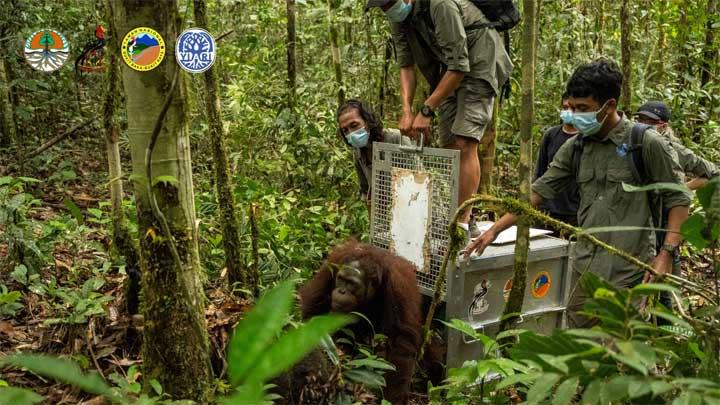
IAR Indonesia (YIARI) Releases Another Seven Orangutans to Freedom! We have wonderful news to share from our partners at International Animal Rescue! Working together, Natural Resources Conservation (BKSDA), Bukit Baka Bukit Raya National Park (TNBBBR), and IAR Indonesia (YIARI) have released another seven orangutans to FREEDOM! This release marks another successful collaboration between BKSDA, TNBBBR, and YIARI and we could not be more excited! The orangutans, who had been under the care of YIARI for many years, were released in TNBBBR in West Kalimantan (Borneo) on October 31, 2024. Female/child pairs Rika/Aben and Karmila/Batis took to the trees along with males Muaro, Onyo, and Lambai. Each of these adult orangutans underwent a lengthy rehabilitation process at the YIARI orangutan center in Ketapang, West Kalimantan. All the orangutans had been rescued from illegal captivity. Under expert care, the orangutans learned and perfected essential skills needed for survival before being considered for release to the forest. During the release, the Head of the West Kalimantan BKSDA, RM Wiwied Widodo, emphasized the importance of preserving Kalimantan's endemic wildlife. "Orangutans are part of Indonesia's biodiversity wealth that must be protected and preserved," he said. These releases are a clear testament to YIARI’s commitment to preserve biodiversity. With support from all parties and supporters like you, we can ensure that orangutans and other species are conserved for future generations. YIARI has released 82 orangutans in conservation areas since 2016. Bukit Baka Bukit Raya National Park was chosen as the release location due to its abundant food sources and suitable orangutan habitat. Special teams, involving the surrounding village community, will now monitor the behavior of the orangutans for 1-2 years, to ensure they are adapting to their new environment. We are so happy for the orangutans and everyone involved in this amazing effort! Let's celebrate this success and keep fighting for a greener and more sustainable future.
Causes We Support
Countries We Serve
United Nations Sustainable Development Goals
In our mission to conserve Critically Endangered orangutans, we know that all solutions to help nature must also benefit human communities, as only then will they be long-lasting and sustainable. Our projects directly preserve biodiversity and combat climate change by protecting biodiversity-rich tropical forest ecosystems that are also huge carbon stores. These projects are implemented by partnering with local, indigenous communities so they are empowered to be the stewards of the land around them and directly benefit from the sustainable income opportunities that follow.